
Introduction to Jean-Michel Basquiat: The Making of an Icon
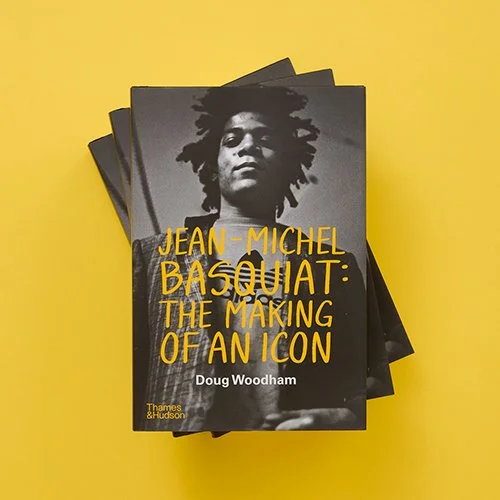
Front Cover of “Jean-Michel Basquiat: The Making of an Icon”
My fascination with Jean-Michel Basquiat took root when I moved to New York City in the early 1980s.
Though his name was familiar to those of us who followed the contemporary art world, opportunities to see his work firsthand were scarce. I was delighted when his name appeared in a New York Times review of a group exhibition featuring four hundred artists. Eager to see his work, I visited the exhibition space—a sprawling, abandoned army depot in Brooklyn. But after wandering through the dystopian venue, I was unable to find any of his pieces. Frustrated, I returned to the entrance and asked the person at the front desk where the work was displayed. I was told that Basquiat’s paintings had been removed due to concerns about theft, as his pieces had suddenly become highly sought after. While my plans to see his work that day were thwarted, my interest in his art only deepened.
Jean-Michel Basquiat, the Brooklyn-born artist who died of a drug overdose in 1988 at the age of twenty-seven, currently stands alongside a handful of others at the pinnacle of what a visual artist can hope to achieve in our world. When one of his paintings sold for $110.5 million at auction in 2017, he joined the exclusive “$100 million club,” alongside luminaries such as Picasso, Modigliani, and Munch. The streets of Rio de Janeiro, Paris, and Singapore are filled with people of all ages wearing T-shirts, shoes, and accessories featuring his art-work or image. Some fans even express their admiration permanently through Basquiat-inspired tattoos, sharing their ink on social media with #basquiattattoo. His cultural impact is so far-reaching that he has become a frequent answer on Jeopardy!
But Basquiat’s ascension into these parallel pantheons of fine art and pop culture was far from certain. Despite starting life with the gifts of a sharp intellect—his family recalled him reading articles in The New York Times by first grade—and a financially stable, middle-class home, he was sidetracked by profound early personal traumas. By his teenage years, he had dropped out of high school and was living on the streets. He was without any formal training as an artist and initially wanted to be a cartoonist. A shy and, in some ways, fragile young man, he also had to face down the challenge of penetrating the elitist con-temporary art world of the early 1980s, where Black artists struggled to find recognition and acceptance.
So how did Basquiat’s work overcome so many obstacles—both during his brief life and after his death—to achieve such critical and commercial acclaim? Like a deity with a broad scope of jurisdiction, he has become a patron saint to many: Basquiat the artistic visionary, Basquiat the truth-telling Black activist, Basquiat the outsider. Yet he was also a real person driven by relatable human motivations.
Since attending that Brooklyn exhibition, I’ve followed Basquiat’s trajectory throughout my career—as a partner at a global management consulting firm; president of Christie’s Americas, the international auction house; and an art advisor to collectors and institutions. What these roles have provided me with is an insider’s view of the forces driving the blue-chip art market, a world often shrouded in opacity, as if its inner workings were best kept behind the canvas. Yet this labyrinthine and occasionally contentious system underscores a broader truth: Understanding how art is valued illuminates why certain artists rise to prominence. Whether one likes to think about it or not, the works that dominate attention and secure pride of place in leading museums and collections have all, at some point, passed a demanding market test.
As I delved deeper into this book, I also came to realize that while Basquiat and I have some of life’s broadest experiences in common—middle-class upbringings in church-going households and a few years’ difference in age—my real connection to him lies in my admiration for his insatiable curiosity, self-directed ambition, and relentless determination to carve out a place for himself in the world. Drawing on my own, albeit very different, experiences in an adjacent part of the art world, along with insights from over a hundred interviews with those connected to Basquiat—family members, friends, lovers, gallerists, collectors of all stripes, museum directors, auction house staff, academics, and artists—I have pieced together how Basquiat and his work achieved the level of recognition they enjoy today.
Since the publication of what was long considered the definitive biography of Basquiat over twenty-five years ago, much has changed with respect to his reputation and in the market for his work. In writing this book, I have drawn not only on the stories shared by those I interviewed, but also on newly available or previously difficult-to- access information about Basquiat’s early life and brief career (including numerous photographs of him, some that have never been published before). These resources have helped uncover fresh insights into his life and art while correcting elements of what has become the accepted narrative. Unraveling the myth to connect with the gifted child, teen-ager, and young artist (who would have turned sixty-five this year) is the focus of the first part of this book.
Basquiat’s personal biography ended tragically in 1988, and until now, that was largely where the story stopped. Therefore my other goal here is to present the biography of his work’s survival and how, in the decades since his untimely death, both the artist and his work have attained an almost mythical status. The legacy of any great artist extends beyond their lifetime, often shaped by a small group of individuals who, motivated by varied interests, ensure the work continues to be seen, known, and experienced. For Basquiat, this was particularly true, given the significant obstacles his work had to overcome to secure the recognition it enjoys today. Additionally, his posthumous reputation was further strengthened by a shift among curators and academics toward examining art through the prism of identity—exploring how an artist’s race, gender, and sexuality inform their engagement with themes such as oppression, discrimination, and inequality. Basquiat not only embodied this evolving paradigm of artistic relevance but also helped to define it. How these and other forces combined to elevate Basquiat’s legacy—until now, the missing chapters of his story—are the focus of the second half of this book.
During his brief but prolific career, Basquiat produced approximately one thousand paintings and two thousand drawings. Many of his most celebrated works are readily accessible online through articles, websites, and Instagram posts. The Basquiat Estate has further capitalized on his legacy by licensing images for a wide array of consumer products, from shoes and underwear to candles and cosmetics. Yet this wave of commercialization masks a more complex and previously untold story—one tied to his highly accomplished but conservative accounting executive father, Gerard—which explains why this book does not include reproductions of Basquiat’s art. Over decades, his father vigorously promoted his son’s work while carefully curating Jean-Michel’s narrative, suppressing elements he found uncomfortable or unacceptable: his traumatic childhood, his bisexuality, and the impact of his addictions on his art. These efforts profoundly influenced Basquiat’s portrayal in exhibition catalogs and museum retrospectives over the past three decades. Ironically, for an artist whose work is so deeply entwined with personal identity, much of the scholarship has glossed over the very experiences that inspired many of his most celebrated creations.
The art world, like many creative industries, selects and elevates its luminaries in ways that can appear enigmatic, inscrutable, or even arbitrary. Yet its influence on our cultural landscape is profound. It is my hope that the stories I share about Jean-Michel Basquiat’s against-all-odds journey from his Brooklyn childhood to the pinnacle of the art world, will help readers understand the surprising and often hidden reasons why his paintings, rather than another artist’s, are on T-shirts worn by people around the world, on the walls of billionaires, and remain such a source of inspiration to creatives globally.